
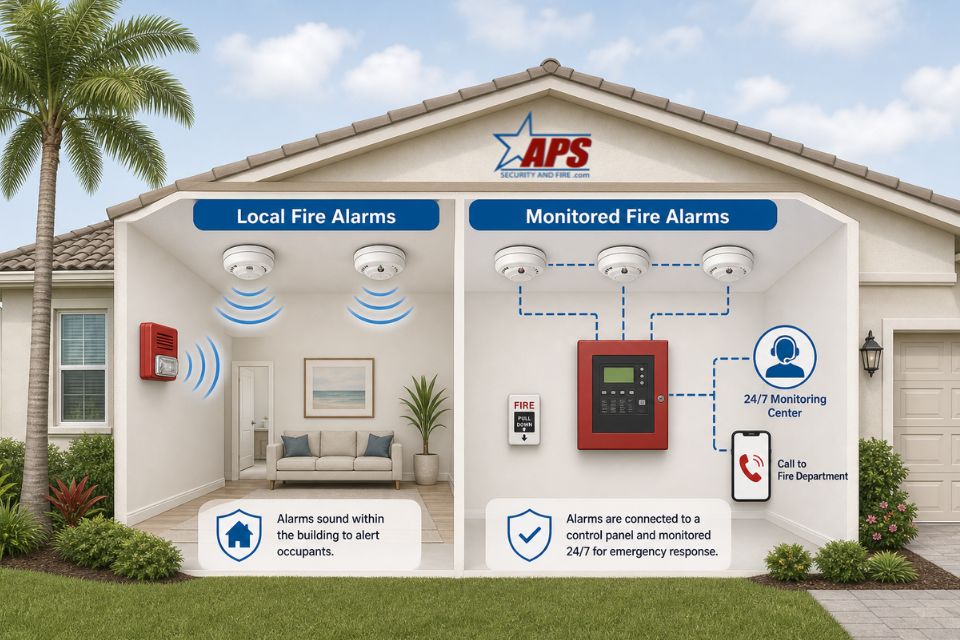
Fire alarms are often talked about as if they all work the same way, but there is an important difference between “local” and “monitored” systems. Both can detect smoke or heat and sound an alert, yet what happens after that alert makes a major difference in how much protection a home actually has.
APS Security and Fire has spent decades helping Central Florida homeowners understand how their fire alarms fit into overall safety planning. Knowing whether your system is local or monitored, and what that means in practice, can help you decide if your current setup gives you the level of protection you expect.
What Local Fire Alarms Do
Local fire alarms are designed to warn people inside the home. When smoke or heat reaches a detector, it triggers a sounder or siren. Everyone nearby can hear it and, ideally, has time to leave the building and call for help.
These alarms can be battery powered, hardwired, or part of a basic security panel, but their response ends at the property line. Once the sounder is active, it is up to someone to notice the alarm, decide what is happening, and contact the fire department. If no one is home, or if neighbors do not hear or recognize the sound, a fire can grow for some time before help arrives.
How Monitored Fire Alarms Work
Monitored fire alarms add another step between detection and response. When a detector activates, it not only sounds locally but also sends a signal to a central monitoring station. Trained operators then attempt to confirm the alarm and contact emergency services in accordance with the account’s instructions.
This connection means the system can call for help even when the homeowner is away or unable to reach a phone. Monitored fire alarms are usually part of a broader security or life-safety system, but their primary purpose is to reduce the time between the start of a fire and the arrival of firefighters.
Why That Difference Matters
The core difference is simple: a local alarm tells people nearby that something is wrong, while a monitored alarm also alerts someone whose job it is to send help. In a fast-moving fire, minutes matter. Local-only systems depend entirely on who is present and how quickly they can act. Monitored systems add a layer of response that does not rely on someone hearing the alarm or making a call.
Local fire alarms can still be valuable, particularly in smaller homes or situations where professional monitoring is not practical. However, assuming a local system functions like a monitored one can create a false sense of security. Homeowners may believe “the alarm will take care of it” when, in reality, the alarm can only sound and wait for someone to respond.
Choosing the Right Approach in Your Fire Alarm Setup for Your Home
Deciding between local and monitored fire alarms starts with how your home is used and what risks you want to address. Homes where people are often away, properties with multiple levels, or households that rely on older wiring or equipment may benefit more from monitored fire alarms.
In other cases, upgrading from standalone local detectors to a system that links detectors together and adds monitoring can provide clearer alerts and faster response. A professional review can help identify where local coverage is strong, where monitored protection would add value, and how to combine both in a way that makes sense for your home.
APS Security and Fire has more than 35 years of experience helping Central Florida homeowners plan, install, and maintain fire alarms that match real-world needs. If you are unsure whether your current setup is local, monitored, or providing the level of protection you want, contact APS Security and Fire to schedule a review of your home’s fire alarm system.