
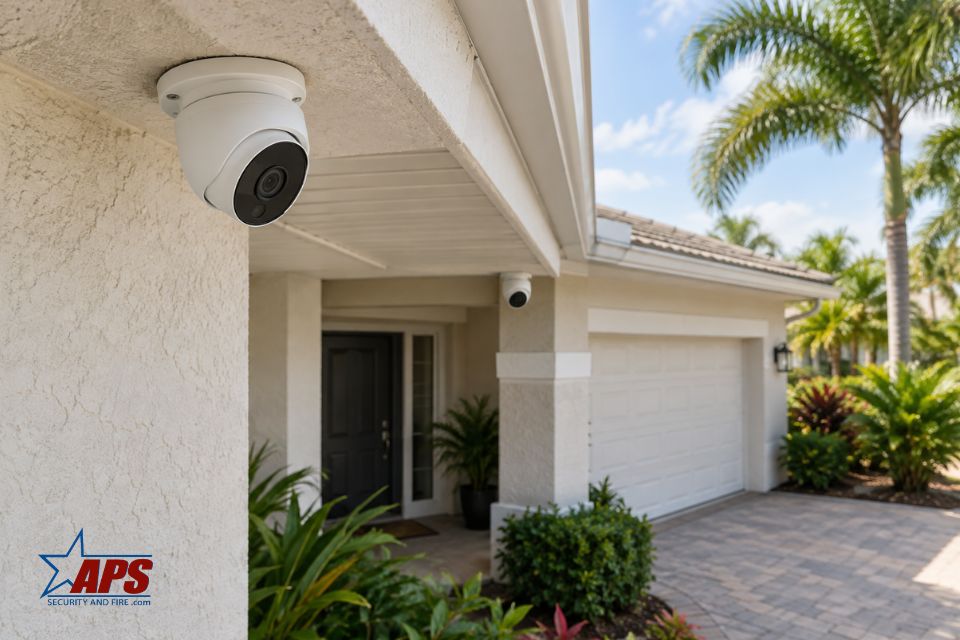
Four to six outdoor security cameras can be a useful starting point, but no single number fits every Florida home. A compact home with clear sightlines may need fewer cameras, while a larger property with multiple entrances and separate buildings may need more.
The goal is not to install as many cameras as possible. It is to cover what matters without paying for unnecessary equipment. APS Security and Fire helps homeowners plan camera coverage around their property’s layout and security needs rather than choosing a package based on camera count alone.
Start with Your Home’s Main Access Points
Before deciding how many security cameras to buy, walk around your home and identify where people approach, enter, or move out of view. Prioritize areas such as:
- The front door and porch
- The driveway and garage entrance
- Back doors and patio entrances
- Side gates and narrow walkways
- Accessible ground-floor windows
- Detached garages or other buildings requiring coverage
Not every location needs a separate camera. One well-placed camera may cover several nearby areas, while entrances on opposite corners usually require different views. Mapping these coverage zones helps you estimate the right number of cameras.
Consider Layout, Not Just Square Footage
Two homes of the same size can have very different security camera needs. A straightforward rectangular layout may offer clear views along exterior walls. A home with recessed entrances, multiple wings, or a detached garage creates more areas to evaluate.
Landscaping, fences, and building corners can also block a camera’s view. Adding another camera may help, but sometimes adjusting the location or angle provides better coverage without increasing the equipment count.
Do Not Expect One Camera to Capture Everything
A camera overlooking the front yard may show someone approaching but won’t provide the same detail as a camera focused on the entrance. Think about what you want each view to accomplish.
Do you need to see visitors at the door, monitor vehicles in the driveway, or watch a side gate? Assigning each camera a purpose helps avoid broad views that obscure important details. Overlapping coverage can also reduce gaps between cameras.
Decide Whether Indoor Cameras Are Necessary
Indoor cameras are a separate decision, not an automatic requirement for every room. Some homeowners want coverage of an entrance or main hallway, while others prefer to keep cameras outside.
If you want indoor coverage, one or two cameras can be a useful starting point for a typical home. Larger homes with multiple floors or separate access routes may benefit from additional cameras, depending on the layout.
Focus on relevant access routes and consider household privacy. Position cameras toward doors and main walkways, not seating or sleeping areas. This keeps coverage focused on movement through the home without unnecessarily monitoring private spaces.
Plan Your Security Camera Coverage with APS Security and Fire
The right camera count comes from matching equipment to your property’s entrances, layout, and visibility. Start with your priorities, identify potential gaps, and confirm that each planned view serves a useful purpose.
APS Security and Fire has helped Central Florida homeowners and businesses secure their properties since 1987. A professional walkthrough can help identify vulnerable areas and guide camera selection and placement before installation.
Contact APS Security and Fire to plan a security camera system that fits your home and coverage needs.